Can Medical Assistants Give Injections? Scope of Practice Explained
Yes — medical assistants can give injections. It’s one of the core clinical skills taught in every quality medical assistant training program and performed routinely in physician offices, clinics, and urgent care centers nationwide.
But the details matter. The types of injections, the level of supervision required, and the specific scope of practice vary by state. Here’s the complete picture.
What Types of Injections Medical Assistants Give
Medical assistants administer injections under the direction of a licensed provider (physician, PA, or NP). The three main types:
Intramuscular (IM) Injections
Delivered into muscle tissue, typically the deltoid (upper arm) or vastus lateralis (thigh):
- Vaccines: flu, COVID-19, Tdap, HPV, hepatitis B, MMR, varicella
- Vitamin B12: commonly administered for deficiency or energy
- Testosterone: hormone replacement therapy
- Antibiotics: certain intramuscular antibiotic formulations
- Corticosteroids: Depo-Medrol, Kenalog for inflammation
Subcutaneous (SubQ) Injections
Delivered into the fatty tissue just below the skin:
- Insulin: diabetes management
- Allergy shots: immunotherapy injections
- Heparin/Lovenox: blood thinning
- Certain vaccines: some are given SubQ rather than IM
Intradermal Injections
Delivered into the dermis (just under the top layer of skin):
- TB skin tests (PPD/Mantoux): the most common intradermal injection MAs perform
- Allergy testing: in some dermatology and allergy practices
Each type requires different technique — needle gauge, insertion angle, injection depth, and site selection are specific to the type.
What O*NET Says About Injection Administration
O*NET lists “administer medications, injections, and immunizations” as a core medical assistant task. It’s not a peripheral duty — it’s central to the job description. The Department of Labor classifies injection administration under the clinical competency domain that medical assistant training programs are expected to cover.
State Scope of Practice
Medical assistant scope of practice is regulated at the state level. In all states, medical assistants give injections under the direction of a licensed provider — meaning a physician, PA, or NP has ordered the injection and the MA carries it out.
Key variations by state:
- Some states specify which injection types MAs can administer
- Some states require formal training documentation (completion of a training program) before MAs can give injections
- Some states require certification (CCMA, CMA, or RMA) for injection administration
- A few states have additional requirements like delegation agreements on file
Your state medical board is the authoritative source for current scope-of-practice rules. The team at Pulse Medical Assistant School can help you understand the specific requirements in your area.
How Training Prepares You
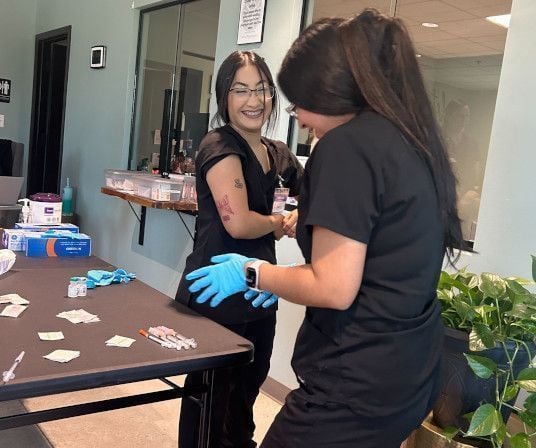
Injection technique requires physical practice — it can’t be learned from a textbook or video alone. Training at Pulse Medical Assistant School includes hands-on injection practice covering:
- Needle selection: Correct gauge and length for each injection type
- Site identification: Proper anatomical landmarks for IM (deltoid, vastus lateralis, dorsogluteal), SubQ (abdomen, upper arm, thigh), and intradermal (inner forearm)
- Technique: Insertion angle (90° for IM, 45° for SubQ, 10–15° for intradermal), aspiration where applicable, and proper injection speed
- Safety: Sharps disposal, needlestick prevention, PPE, and documentation
- Patient management: Preparing patients, managing anxiety, monitoring for adverse reactions
The Career Impact
Injection competency isn’t optional for medical assistants — it’s expected. Job postings that list “administering injections” as a required skill represent the vast majority of available MA positions. MAs who can’t give injections are immediately less competitive and limited in where they can work.
The CCMA certification exam tests injection knowledge. Training programs that integrate injection practice throughout the curriculum (not just a single lab day) produce graduates who perform this skill confidently from day one.
Get Trained
Pulse Medical Assistant School covers injection technique throughout its 16-week program — IM, SubQ, and intradermal, with hands-on practice using real equipment.
- See the full program: Program details
- Review tuition and payment plans: Tuition
- Talk to our team: Contact
- Apply: How to apply
You're only a few months from the medical assistant career you deserve.