Medical Assistant Online Programs: Why Hybrid Training Works and Fully Online Doesn't
If you’ve been searching for medical assistant online programs, you’ve probably already noticed the range. Some programs are fully online with no in-person component. Some are traditional in-person programs that added a Zoom option. And some — the genuinely effective ones — are built from the ground up as hybrid programs that use online delivery for what it’s good at and in-person training for what it can’t replace.
Here’s how to tell the difference, and why it matters more than you might think.
What online delivery works well for in medical assistant training
Let me be direct: online delivery is genuinely effective for a significant portion of medical assistant training. That includes:
- Medical terminology and anatomy — concepts you learn through study and repetition, not physical practice
- Clinical theory — understanding why you perform a procedure before you practice how
- Administrative skills — EHR documentation, scheduling, insurance verification, medical billing basics
- HIPAA compliance — policy and practice, covered through instruction and case-based learning
- Exam preparation — CCMA review sessions, practice questions, test strategy
- Instructor Q&A and case discussions — easily handled through live video sessions
For all of this, online learning is not a compromise. Done well — with live, instructor-led sessions rather than just pre-recorded videos — it’s comparable to or better than a physical classroom for conceptual learning.
Where online delivery falls short for medical assistants
The clinical skills required of medical assistants are physical. There is no way around this. Drawing blood involves needle control, vein selection, and patient management that you cannot develop by watching a video. Running an EKG requires knowing how to place 10 electrodes correctly and troubleshoot artifact in real time. Taking a manual blood pressure requires practiced hand coordination and the ability to hear Korotkoff sounds accurately.
Fully online medical assistant programs — programs with no in-person component — cannot teach these skills to job-ready standards. Students who complete them often struggle significantly in externship placements and on their first day at work.
This isn’t a minor gap. Clinical skills are the core of the job. A graduate who can’t draw blood, take a manual BP, or run an EKG competently isn’t ready to work as a medical assistant, regardless of what their certificate says.
How Pulse Medical Assistant School builds the hybrid model
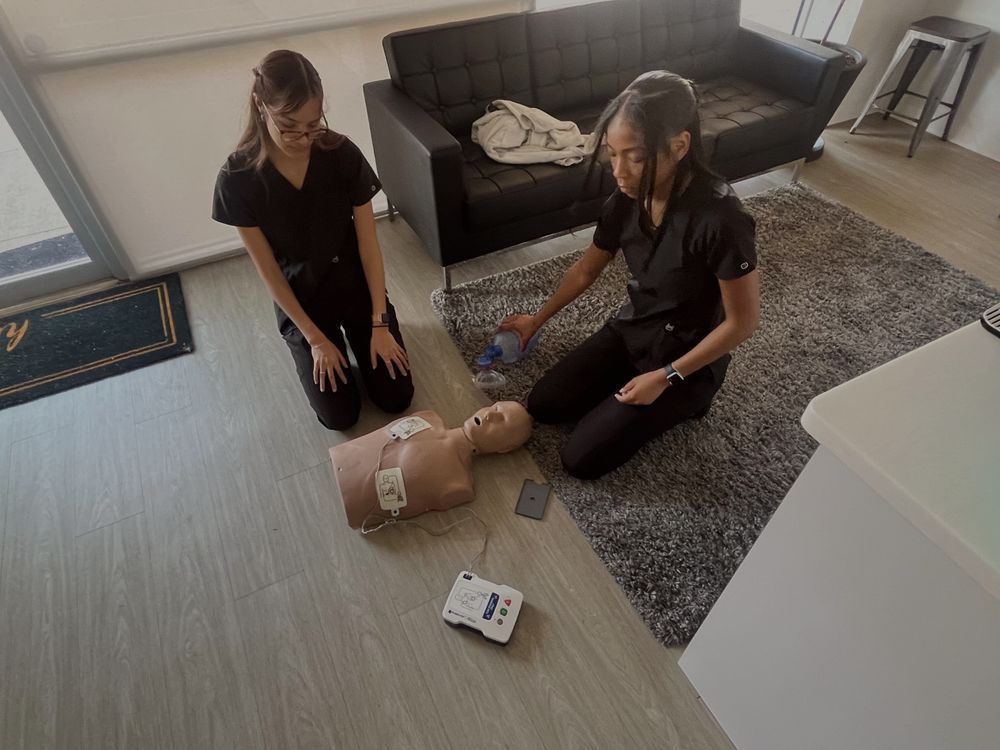
Pulse Medical Assistant School is structured as a genuine hybrid medical assistant online program: most learning happens online in live, instructor-led sessions, and clinical skills are developed in 4 intensive in-person labs. Both components are required. Neither is optional.
Online component (16 weeks, live sessions)
- Medical terminology, anatomy, and physiology fundamentals
- Clinical procedures: step-by-step instruction, rationale, and technique review
- Phlebotomy and injection theory before lab practice
- Administrative training: EHR systems, scheduling, billing, insurance
- CCMA certification preparation integrated throughout
- Direct access to instructors — not just recorded content
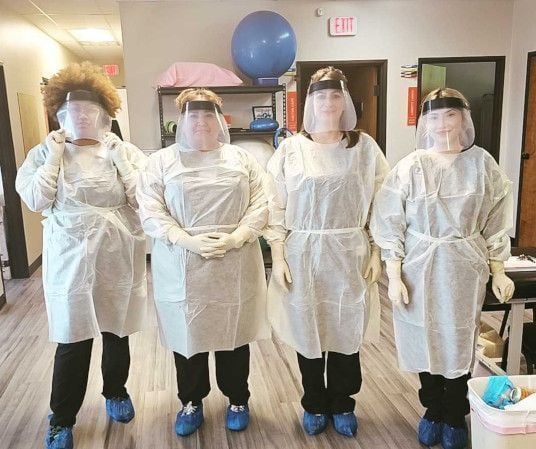
In-person labs (4 full-day sessions)
These are structured around the complete clinical skill set of a medical assistant:
- Phlebotomy — venipuncture (vacutainer and butterfly systems), capillary puncture, specimen handling
- Injections — subcutaneous, intramuscular, and intradermal technique on anatomical trainers and real patients
- Vital signs — manual blood pressure, pulse oximetry, temperature, respiratory rate, BMI
- EKG — 12-lead electrode placement, equipment operation, identifying and correcting artifact
- Point-of-care testing — urinalysis, blood glucose, rapid strep, flu, pregnancy tests
- Clinical procedures — exam room prep, instrument sterilization, provider assistance
Each lab day is full-day and intensive — not a two-hour session crammed with a dozen students. You practice, receive feedback, correct, and practice again.
Externship
After completing online sessions and all four in-person labs, students complete supervised hours in a real medical office — a physician’s practice, urgent care center, or specialty clinic. This is where training meets the actual job.
The CCMA: what it is and why the program is built around it
The Certified Clinical Medical Assistant (CCMA) credential is awarded by the National Healthcareer Association (NHA) and is one of the most recognized certifications in the field. Employers use it as a signal that a candidate has verified, standardized clinical and administrative competency.
At Pulse Medical Assistant School, CCMA preparation is integrated throughout the 16-week program — not added in the final week. Students sit for the exam prepared, not scrambling.
The certification matters in two concrete ways:
- Hiring — many employers prefer or require a credentialed MA over an uncredentialed one
- Pay — certified MAs consistently out-earn uncredentialed peers in comparable positions
Total cost: $2,990
The all-inclusive cost of the Pulse Medical Assistant School program is $2,990. That covers:
- 16 weeks of live online instruction
- All 4 in-person lab days
- Externship placement
- CCMA exam preparation
- Program materials
No financial aid is accepted. Students graduate debt-free. Payment plans are available for those who prefer to spread the cost across the program.
For context: $2,990 is below the cost of a single semester at many community colleges. It’s also below the cost of most bootcamp-style programs. And it includes CCMA certification prep, which other programs charge separately.
Who this works well for
Hybrid medical assistant online programs are designed for:
- Working adults who can’t commit to a traditional in-person schedule
- Career changers who need to retrain efficiently
- Parents balancing education with family obligations
- People in areas with limited local school options
- Students who want online flexibility without sacrificing clinical preparation
Job outlook and salary
The Bureau of Labor Statistics projects 14% job growth for medical assistants through 2032. The national median salary is approximately $42,000 per year, with entry-level positions typically starting in the $33,000–$38,000 range.
The 16-week timeline at Pulse Medical Assistant School means you enter that job market faster than students in longer programs — and at a lower total cost than virtually any comparable credential.
Get started with Pulse Medical Assistant School
- Full program structure: Program details
- Cost and payment options: Tuition
- Talk to our team: Contact us
- Apply: How to apply
You're only a few months from the medical assistant career you deserve.