Online Medical Programs: What's Real, What's Not, and How Hybrid Changes Everything
Online medical programs have exploded in popularity over the last several years — but not all of them are what they claim to be. Some are fully online in a way that works. Others are fully online in a way that leaves you completely unprepared for clinical work. Knowing the difference before you enroll could save you thousands of dollars and months of your time.
This is an honest look at what online medical programs can and can’t deliver, why the hybrid model changes the equation, and what to actually look for before you commit.
What “online” means in healthcare training — and where it falls short
The appeal of online healthcare training is obvious. You study on your own schedule, skip the commute, and fit coursework around a job or family. For the right parts of a medical program, online delivery works well.
For clinical skills, it doesn’t — at least not on its own.
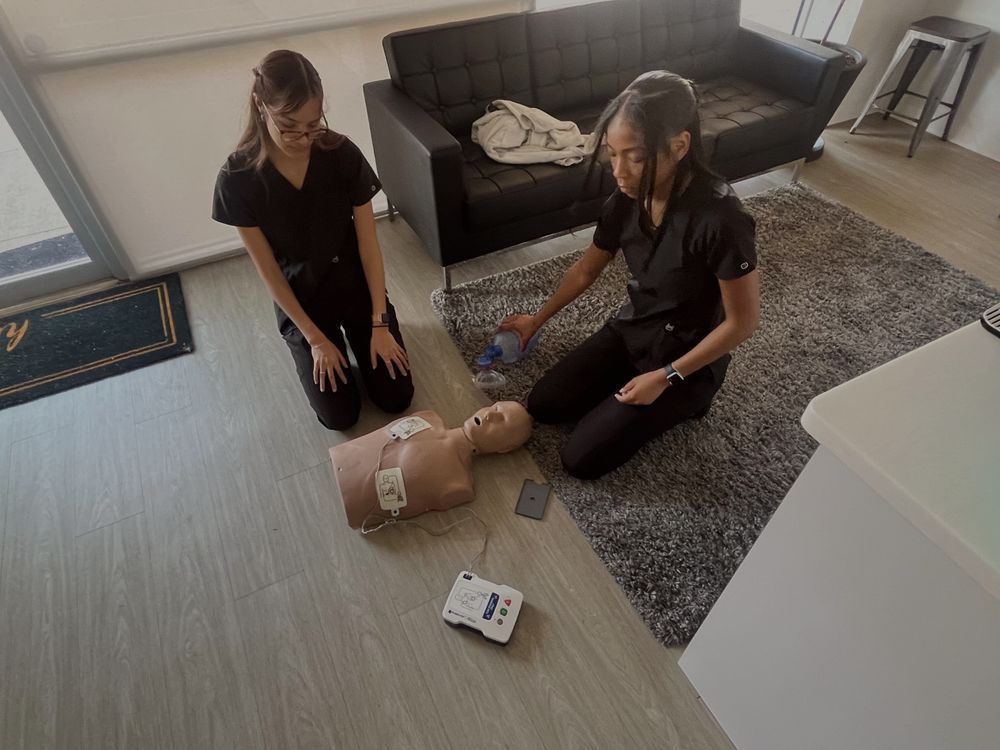
Medical assisting involves drawing blood, taking vital signs, running EKGs, administering injections, and performing point-of-care lab tests. These are physical, hands-on skills that you can watch on video and understand conceptually, but cannot actually develop without practice on real equipment with real feedback.
Fully online online medical programs that claim to cover clinical training through videos and simulations are not preparing you for what happens when you’re standing next to a real patient on your first day of work. That’s not an opinion — it’s the basic mechanics of skill acquisition.
What a hybrid model actually solves
The hybrid approach to online medical programs separates what can be learned effectively online from what has to be learned in person, then delivers each component the way it actually works best.
At Pulse Medical Assistant School, that looks like this:
Online (live, instructor-led sessions):
- Medical terminology and anatomy fundamentals
- Clinical procedures: theory, rationale, and technique walkthrough
- Administrative skills: EHR documentation, billing basics, scheduling
- HIPAA compliance and patient privacy standards
- CCMA exam preparation and review sessions
- Direct instructor access for questions during and between sessions
In-person labs (4 intensive full-day weekend sessions):
- Hands-on phlebotomy — venipuncture and capillary draws on real patients
- Injection technique: subcutaneous, intramuscular, intradermal
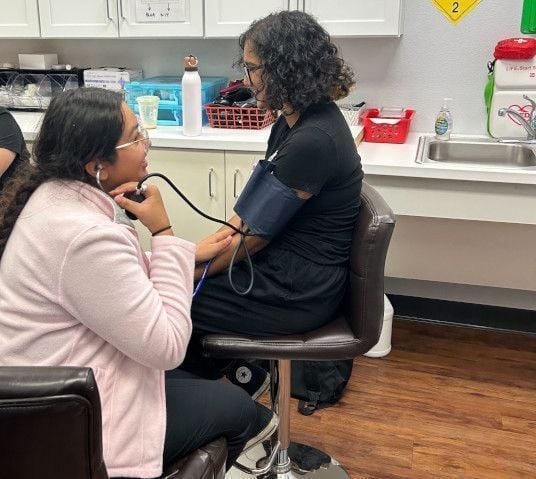
- Vital signs: manual blood pressure, pulse oximetry, temperature
- EKG/electrocardiography: lead placement and equipment operation
- Point-of-care testing: urinalysis, glucose, rapid tests
- Exam room setup, instrument sterilization, procedure assistance
- Real medical office environment — not a classroom simulation
The result is a program that’s genuinely flexible (because most of it is online and asynchrony-friendly) while still producing graduates who can actually perform clinical work on day one.
Why 4 in-person labs is the right number
It raises a fair question: if clinical skills require in-person practice, why only four labs? Shouldn’t there be more?
The answer is in how skills training actually works. Repetition matters, but you reach a point of diminishing returns quickly with basic lab skills. The goal isn’t to log hours — it’s to achieve competency under supervision. Four full-day labs, structured around the complete clinical scope of a medical assistant role, are enough to build the foundation. The externship component then extends and consolidates that foundation in a real medical office.
Four intensive days — not four hours, four full days — is a meaningful commitment. It’s enough time to move from watching to doing to getting real feedback to doing it again correctly.
The externship: where online preparation meets real clinical work
The externship component of a hybrid online medical program is where everything comes together. After completing online sessions and in-person labs, students complete supervised practice hours in an actual clinical setting — a physician’s office, urgent care clinic, or specialty practice.
This is where skills get consolidated:
- Real patients with real presentations (not mannequins or classmates)
- Real time pressure between appointments
- Real feedback from working medical professionals
- Real professional connections that often lead directly to employment
The externship is also why hybrid programs can legitimately prepare students for clinical work in a way that fully online programs cannot. It’s the bridge between training and the job.
The cost picture for online medical programs
One of the practical advantages of hybrid online medical programs is cost. Reducing the need for a physical campus infrastructure — full-time lab facilities, large classroom spaces, on-site administrative overhead — allows programs to pass savings to students.
At Pulse Medical Assistant School, total program cost is $2,990 — all-inclusive. That covers:
- All 16 weeks of live online instruction
- All 4 in-person lab days
- Externship placement
- CCMA certification exam preparation (included in tuition)
- Program materials and supplies
No financial aid is accepted — which means no federal loans, no debt that follows you after graduation. Students who complete the program graduate debt-free. Payment plans are available to spread the cost across the program timeline.
At under $3,000, the total cost is lower than a single semester at many community colleges — and the program gets you into the workforce in 16 weeks.
What CCMA certification means and why it’s included
The Certified Clinical Medical Assistant (CCMA) credential from the National Healthcareer Association (NHA) is one of the most widely recognized certifications in medical assisting. It demonstrates that you’ve met a verified standard of clinical and administrative competency.
Certification preparation is built into the Pulse Medical Assistant School curriculum — not offered as an optional add-on. By the time you complete the 16-week program, you’re prepared to sit for the CCMA exam. The certification itself opens doors that uncredentialed training doesn’t: many employers prefer or require certification, and credentialed medical assistants consistently earn more in the same markets.
Who hybrid online medical programs are designed for
The hybrid model works especially well for:
- Working adults who can’t attend a traditional in-person program on a fixed daily schedule
- Parents and caregivers who need schedule flexibility but want real clinical training
- Career changers who want to retrain efficiently without leaving their current income entirely
- People in markets with limited local school options — hybrid programs extend access geographically without eliminating the in-person requirement for clinical skills
- Anyone who’s tried a fully online program and didn’t feel prepared for clinical work
Job outlook for medical assistants
The Bureau of Labor Statistics projects 14% growth in medical assistant employment through 2032 — nearly double the national average for all occupations. The national median salary is approximately $42,000 per year, with entry-level positions typically starting in the $33,000–$38,000 range.
The combination of growing demand and accessible training costs makes this one of the more straightforward ROI calculations in career training. A 16-week hybrid program at $2,990 that prepares you to earn $36,000–$42,000 pays for itself within the first few months of employment.
Get started with Pulse Medical Assistant School
- See the full program structure: Program details
- Review tuition and payment plans: Tuition
- Talk to our team: Contact us
- Apply: How to apply
You're only a few months from the medical assistant career you deserve.