CMA Certification: What It Is, Why It Matters, and How Pulse Gets You There
The letters after your name matter in healthcare. When medical offices are sorting through applications, CMA certification — specifically the CCMA credential — is one of the first things they check. It tells them your skills have been tested independently, that you met a national standard, and that you didn’t just complete a program but proved what you learned.
Here’s exactly what the CCMA certification is, why it carries weight with employers, how the exam works, and how Pulse builds the entire process into a 16-week program that costs under $3,000.
What CMA certification actually means
“CMA” stands for Certified Medical Assistant. The most widely recognized credential in clinical medical assisting is the CCMA — Certified Clinical Medical Assistant — issued by the National Healthcareer Association (NHA).
This isn’t a certificate of completion from your school. It’s a national credential earned by passing a standardized exam that tests your knowledge and clinical competency across the full scope of medical assistant work:
- Medical law and ethics
- Medical terminology and anatomy
- Infection control and sterilization
- Phlebotomy and specimen collection
- Vital signs and patient assessment
- EKG/ECG performance and interpretation
- Medication administration and pharmacology basics
- Administrative skills and EHR documentation
Passing this exam means you’ve demonstrated a baseline of competency that employers across the country recognize and trust. It’s the difference between a candidate who says they can do the work and one who has proof.
Why employers prioritize CCMA-certified candidates
It affects whether you get hired
Many medical offices list CCMA certification as a requirement — not a preference. In competitive markets, being uncertified means your application doesn’t make it past the initial screen. Certification gets you in the door.
This is especially true in specialty practices — cardiology, dermatology, oncology, orthopedics — where providers expect clinical staff to meet a national standard before they start.
It affects your starting salary
According to Indeed and Glassdoor (2026), CCMA-certified medical assistants earn measurably more than their non-certified counterparts:
- Non-certified MAs: $32,000–$36,000/year starting
- CCMA-certified MAs: $36,000–$42,000/year starting
- Annual premium: approximately $2,000–$6,000+
That premium compounds over time. Over five years, certification can mean $10,000–$30,000+ in additional earnings compared to staying uncertified.
It gives you negotiating leverage
A certified MA walks into salary discussions with documented proof of competency. A non-certified candidate has to ask employers to trust their word. The difference in your position during those early conversations is significant — and the financial impact carries through your entire career.
It opens specialty doors
Some high-paying specialties — cardiology, oncology, dermatology — prefer or require CCMA certification for clinical roles. Certification doesn’t just help you get hired; it expands the universe of positions you can pursue from day one.
It’s portable and nationally recognized
The CCMA credential travels with you. Whether you move to a different city, change employers, or transition between specialties, the certification remains valid and recognized. It doesn’t expire for two years, and renewal involves straightforward continuing education requirements.
How the CCMA exam works
The exam is administered by the NHA and can be taken at approved testing centers or via remote proctoring online.
Format:
- 150 multiple-choice questions
- 3-hour time limit
- Scaled scoring system (not percentage-based)
What it tests — broken down by domain:
- Medical terminology and anatomy — understanding the language and structures of the human body, from organ systems to clinical abbreviations
- Medical law, ethics, and professionalism — patient rights, HIPAA compliance, scope of practice, and professional conduct standards
- Patient intake and documentation — taking medical histories, documenting chief complaints, preparing patients for examinations
- Clinical procedures — phlebotomy, injections, EKG/ECG, specimen collection, minor procedures, and wound care
- Infection control — sterilization techniques, OSHA compliance, bloodborne pathogen standards, PPE protocols
- Pharmacology basics — drug categories, routes of administration, dosage calculations, and medication documentation
- Administrative functions — scheduling, insurance verification, EHR documentation, and referral processing
Passing: The NHA uses a scaled scoring system, and Pulse’s integrated curriculum is designed to prepare you for a passing score — not just the theory, but the clinical application the exam assesses.
How Pulse integrates CMA certification prep from day one
Exam prep built into every module
Pulse doesn’t tack certification prep onto the end of the program. CCMA exam content is woven throughout the 16-week curriculum, so by the time you’re in your final weeks, you’ve already been preparing for months — not cramming a four-month syllabus into a few days.
Each week’s content is mapped to CCMA exam domains. Live sessions on Tuesday evenings reinforce knowledge. Weekend lab days build the clinical skills. The externship provides supervised real-patient contact.
CCMA exam fee included in tuition
At $2,990, Pulse’s tuition includes the CCMA exam fee. You don’t receive a separate bill after graduation. The credential is part of what you’re investing in from the start.
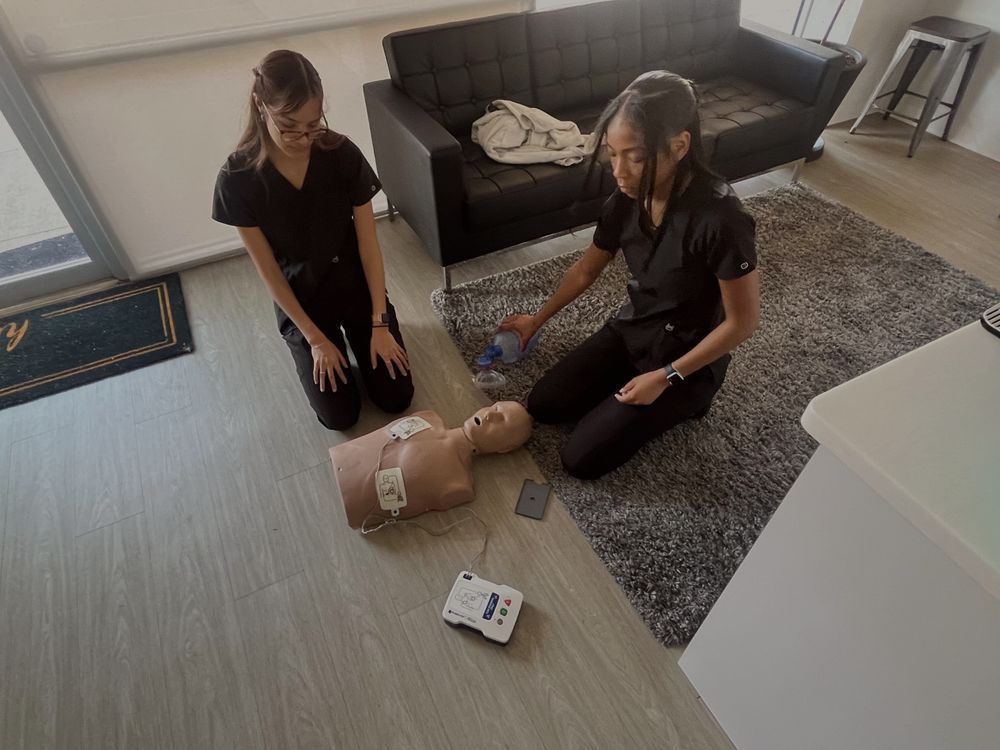
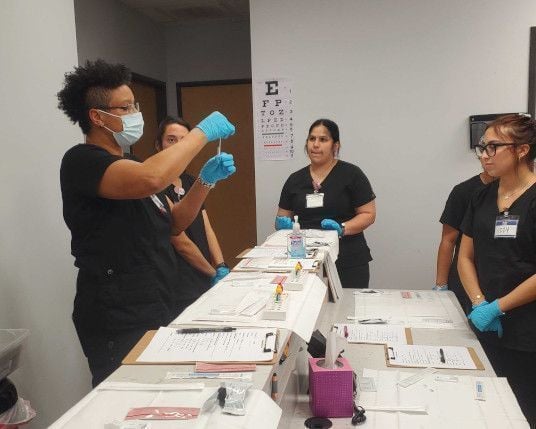
4 in-person lab days in real medical offices
The CCMA tests clinical skills you can only develop through hands-on practice. Pulse’s four full-day lab sessions — held in real partner medical offices, not campus classrooms — cover exactly what the exam assesses:
- Phlebotomy and venipuncture technique
- Vital signs: blood pressure, pulse, respiratory rate, oxygen saturation, temperature
- Injections: intramuscular, subcutaneous, intradermal
- 12-lead EKG electrode placement and artifact recognition
- Specimen collection and processing protocols
- Wound care and sterile technique
Practicing these skills in actual clinical environments — with real equipment and the layout of a functioning medical office — produces a different level of readiness than classroom simulations.
Externship: supervised real-world contact
Pulse’s externship component provides supervised clinical hours in a working medical office before you graduate. This bridges the gap between lab practice and independent employment, and reinforces the hands-on skills the CCMA exam measures.
What happens after you earn the CCMA
Once certified, the job search typically moves quickly. Employers actively prioritize CCMA-certified candidates, and most Pulse graduates find positions within 2–4 weeks of completing the program.
Your starting salary reflects your credential. Certified MAs don’t have to negotiate from a position of “please trust me” — they negotiate with documentation in hand.
The total timeline from enrollment to working as a certified medical assistant: approximately 5 months.
Common questions about CMA certification
Do I need prior healthcare experience to prepare for the CCMA? No. Pulse is designed for complete beginners and career changers. The program builds from foundational knowledge up through advanced clinical skills, and the curriculum prepares you for the exam regardless of your starting point.
How hard is the CCMA exam? Passing rates vary, but students who complete comprehensive preparation programs — especially those with strong clinical components — consistently perform well. Integrated prep is more effective than last-minute cramming.
Can I retake the exam if I don’t pass? Yes. The NHA allows retakes with a waiting period. Pulse’s team can support you through additional prep if needed.
Does the CCMA expire? Yes — after two years. Renewal requires continuing education credits, which are straightforward to complete while you’re working in the field.
What CCMA-certified MAs say about the credential
Across medical assisting forums, LinkedIn conversations, and graduate testimonials, the consistent theme from CCMA-certified MAs is straightforward: the credential changed their hiring experience. Applications that previously didn’t receive callbacks started generating interviews. Offers came in at higher starting salaries. Employers treated certified candidates differently from the first conversation.
The CCMA doesn’t guarantee employment — no credential does. What it does is remove the most common barrier to getting seriously considered: the employer’s uncertainty about whether you actually know what you’re doing.
For career changers especially, certification is the way you communicate competency to employers who have no prior professional relationship with you. It’s the external validation that makes your application credible.
Start building toward your CCMA
Pulse’s 16-week program includes clinical training, exam preparation, and the CCMA exam fee — all for $2,990. Payment plans as low as $112.50/week make it accessible without student loans.
- See the full program: Program details
- Review tuition and payment plans: Tuition
- Talk to our team: Contact
- Apply: How to apply
You're only a few months from the medical assistant career you deserve.