Medical Assistant Certification Online: How Pulse's Hybrid Model Actually Works
The phrase medical assistant certification online gets searched a lot — usually by people who want a career in healthcare but also have jobs, families, and schedules that make full-time campus attendance unrealistic.
The appeal is obvious. But the question that follows immediately is the right one: how do you learn to draw blood, run an EKG, or administer an injection through a screen?
The honest answer is: you can’t learn those skills through a screen alone. And any program that claims you can is either misleading you or setting you up to walk into a job unprepared. What you can do online — and do well — is learn the knowledge: anatomy, terminology, pharmacology, medical law, documentation, infection control. Then you practice the clinical skills in structured, hands-on sessions with real equipment.
That’s exactly how Pulse is designed, and it’s why the model works.
The hybrid structure: where online ends and in-person begins
Pulse’s program is online-first — meaning the majority of your learning happens remotely. But online-first is not the same as online-only. Understanding the distinction is critical when evaluating programs.
The online side: knowledge and understanding
Live Tuesday evening sessions — not pre-recorded videos, but live virtual classes with a real instructor and your cohort. You ask questions in real time. You work through case scenarios together. You get feedback on knowledge before exam day.
Self-paced coursework — readings, digital assignments, and knowledge checks you complete between sessions on your own schedule. This is where you absorb medical terminology, anatomy, infection control protocols, pharmacology basics, and administrative procedures.
CCMA exam prep integrated throughout — every module connects directly to what the NHA’s CCMA exam tests. You’re not preparing separately for the credential; you’re building toward it from week one.
This online component handles everything that can be handled online effectively. It’s not padded with unnecessary content — it’s calibrated to cover exactly what a medical assistant needs to know.
The in-person side: skills you can only build with your hands
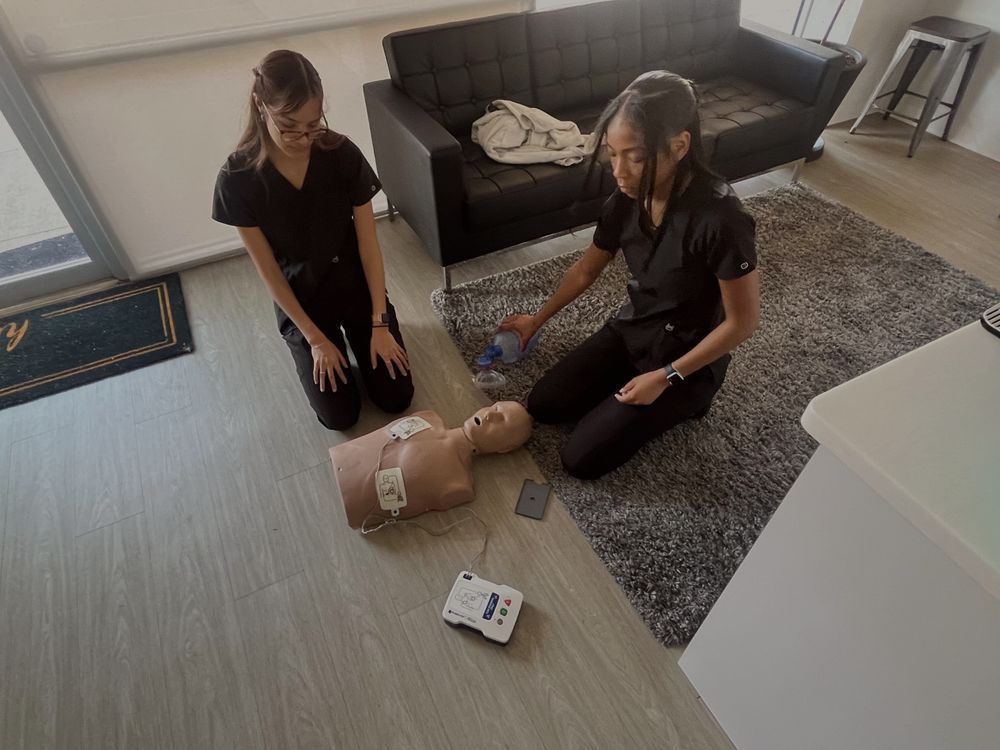
Four full-day lab sessions — spread across the 16-week program — are where clinical competency becomes real. These sessions happen in real partner medical offices, not campus classrooms with models and mannequins.
What you practice in those labs:
Phlebotomy:
- Venipuncture technique — butterfly and straight needle
- Blood draw positioning and patient preparation
- Specimen labeling and chain of custody procedures
- Handling difficult draws and patient anxiety
Vital signs and patient assessment:
- Blood pressure — manual and electronic
- Pulse assessment and rhythm recognition
- Oxygen saturation monitoring
- Temperature methods (oral, tympanic, temporal)
- Respiratory rate and documentation
Injections:
- Intramuscular technique — deltoid, vastus lateralis, ventrogluteal sites
- Subcutaneous injections — insulin, vaccines
- Intradermal injections — TB testing technique
- Sterile draw technique and air bubble management
EKG/ECG:
- 12-lead electrode placement — accurate positioning for clean tracings
- Running the EKG: patient preparation, lead attachment, tracing acquisition
- Identifying common artifacts and repositioning to correct them
Specimen collection:
- Urine collection protocols — clean catch and catheter
- Throat and nasopharyngeal swabs
- Wound culture collection
Infection control and sterile technique:
- Instrument sterilization and autoclave operation
- OSHA-compliant sharps disposal
- Sterilization documentation
Externship: supervised patient contact before graduation
Pulse’s program includes an externship component — supervised clinical hours in a working medical office. This is where everything comes together: the knowledge from online sessions, the technical skills from lab days, and the interpersonal skills of patient care under real conditions.
Many students find their first jobs through connections made during externship.
Why online-only certification programs fall short
Some programs advertise full medical assistant certification online with no in-person requirement. The problem is structural: the CCMA exam tests clinical competency, and clinical competency requires hands-on practice to develop.
Specific issues with online-only programs:
Employers screen for clinical skills in interviews. If you’ve never performed a blood draw, your first attempt at describing your technique in an interview will reveal the gap. Clinical hiring managers notice immediately.
Orientation periods are longer and more expensive. Practices that hire uncredentialed candidates must invest weeks of supervision to get them up to clinical standards — and increasingly, they prefer not to.
Externship becomes the job — without supervision. Some online-only programs include an externship at the end, which means a student’s first clinical contact comes with limited preparation and no safety net from structured lab practice.
Pulse’s hybrid model solves all of these problems. You arrive at lab days with the knowledge from online sessions already in place, so you can focus on developing the physical skill rather than learning the theory and the technique simultaneously.
The complete timeline: enrollment to employed
| Phase | Notes |
|---|---|
| Online learning (weeks 1–16) | Live Tuesday sessions + self-paced coursework |
| 4 in-person lab days | Full-day sessions in real medical offices |
| Externship | Supervised clinical hours, integrated into program |
| CCMA exam | Taken within 2–3 weeks of graduation |
| Job search | Typically 2–4 weeks for certified graduates |
| Total: ~5 months | From enrollment to employed |
What you actually learn in the online component
One concern people have about online learning is whether it sticks — whether watching videos and reading course materials translates into real knowledge you can use under pressure in a clinic. Here’s how Pulse addresses that:
Live instruction, not passive video
The Tuesday evening sessions are live. An instructor is teaching in real time, fielding questions, working through clinical scenarios, and connecting theory to practice. This is meaningfully different from watching recorded content on your own schedule. Live sessions create accountability, promote retention, and allow you to get immediate clarification on anything that’s unclear.
Scenario-based learning
Clinical scenarios — patient cases that require you to apply knowledge, not just recall it — are built into the online curriculum. You practice making the kind of judgment calls MAs make every day: how to respond to an abnormal vital sign, how to handle a medication question, when to escalate to the provider.
Built-in check-ins
Module assessments and knowledge checks throughout the program ensure you’re genuinely absorbing material — not just advancing through slides. If there are gaps, you identify them early, before the in-person lab days where you’ll apply what you’ve learned.
Connection to certification domains
Every module is mapped to CCMA exam content areas. By the time you complete the program, you’ve covered the full exam blueprint — not in a last-minute review sprint, but systematically over 16 weeks.
Frequently asked questions about online MA certification
Can I work full-time while doing the program? Yes. Live sessions are Tuesday evenings, and lab days are on weekends. Your weekday work schedule is protected. Most Pulse students remain employed during training.
What technology do I need? A reliable internet connection and a device capable of video conferencing (laptop, tablet, or desktop). No specialized software or equipment required from the student side.
Is the CCMA exam taken online or in person? The NHA offers both options — approved testing center or remote proctored online. You choose the format that works best for you.
What if I fall behind in the self-paced portion? The live sessions create weekly structure. If you’re struggling with coursework, Pulse’s support team can help you realign before lab days.
Who Pulse’s online-first model is built for
This structure works especially well for:
- Working adults — live Tuesday evenings keep your weekdays free
- Parents and caregivers — flexible online learning, weekend labs instead of daily commutes
- Career changers — manageable enough to train while transitioning out of another job
- People who need structure and accountability — live sessions provide it; self-paced coursework builds habits
No prior healthcare experience is required. No prerequisites beyond a high school diploma or GED.
What’s included at $2,990
- Full 16-week curriculum (live online + self-paced)
- 4 in-person lab days in real medical offices
- Externship component
- CCMA exam prep integrated throughout
- CCMA exam fee — no separate charge after graduation
- Weekly payment plan options (as low as $112.50/week)
-
Graduate completely debt-free
- See how the program works: Program details
- Review tuition and payment options: Tuition
- Talk to our team: Contact
- Apply: How to apply
You're only a few months from the medical assistant career you deserve.