Medical Assistant Online Certification: What's Real, What's Not, and How Hybrid Changes Everything
The appeal of “fully online medical assistant certification” is obvious — learn on your own schedule, no commute, no fixed classroom hours. But the reality of what fully online programs deliver is more complicated, and for a clinical role like medical assisting, the limitations matter more than most program marketing will tell you.
Here’s an honest breakdown of what online MA certification can and can’t deliver, how hybrid programs like Pulse differ, and what actually matters when you’re choosing between them.
What “fully online” medical assistant programs actually deliver
Fully online MA programs have grown significantly in the last several years. They offer convenience, and for the knowledge side of medical assisting — anatomy, medical terminology, pharmacology basics, infection control concepts — they can be effective.
What they struggle with:
Phlebotomy technique. Blood draws require tactile muscle memory. The angle of insertion, the feel of a vein under the skin, the stabilization technique, proper vacuum tube sequencing — these are physical skills that video instruction and written tests cannot adequately teach. Programs that claim to certify phlebotomy competency through fully online coursework are, in practice, certifying theoretical knowledge only.
EKG electrode placement. A 12-lead EKG requires correct anatomical placement of 10 electrodes. You can memorize the placement chart from a diagram. But the first time you’re on a real patient with irregular anatomy or body hair or poor lead contact, the muscle memory from having done it in a real clinical setting makes the difference between a clean reading and a repeat attempt.
Injection technique. IM, subcutaneous, and intradermal injections each have specific needle angles, insertion depths, and aspiration protocols. These are not skills that should be practiced for the first time on a real patient.
Clinical workflow and pace. Real medical offices operate under time pressure. Patient throughput, instrument handling, room turnover, responding to provider requests in sequence — the pace and coordination of clinical work are things you can read about but only really learn by being in it.
The certificate you receive from a fully online program is real. The gap in hands-on preparation is also real.
What online-first hybrid means at Pulse
Pulse describes its program as “online-first hybrid.” That’s a specific combination worth understanding:
Online-first means the majority of content delivery — medical science, terminology, procedures, pharmacology, administrative systems — happens through an online platform. Self-paced modules combined with live Tuesday evening sessions led by instructors. You’re not required to be in a physical location most days.
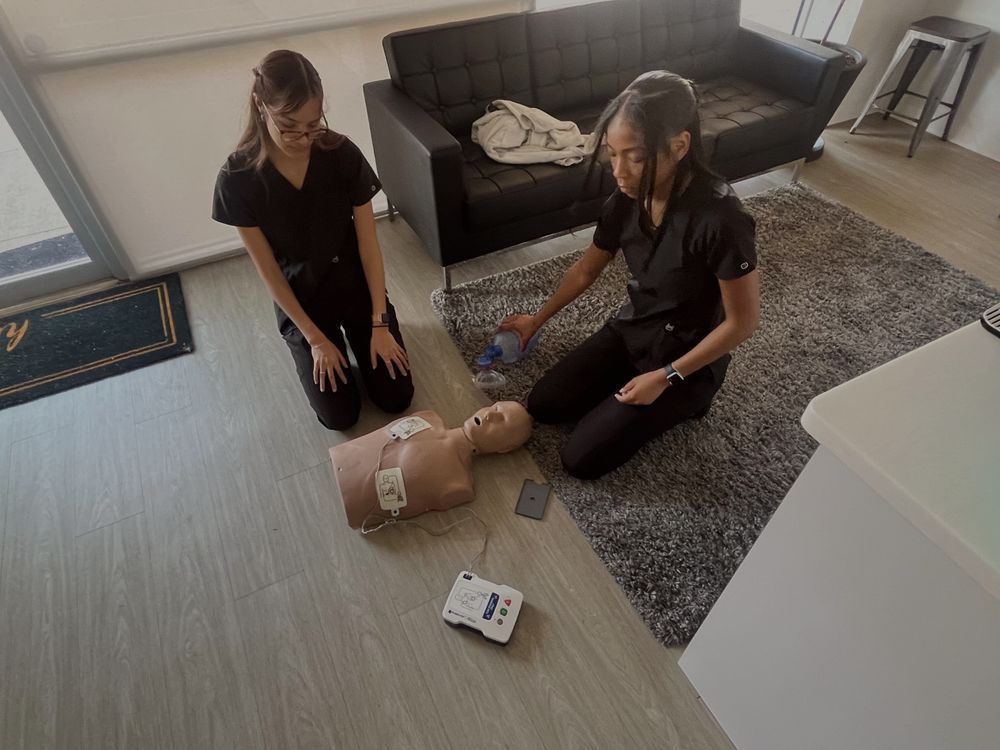
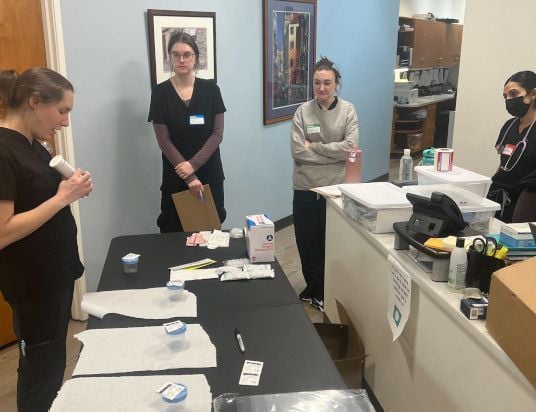
Hybrid means the program is structurally incomplete without the in-person component. Pulse’s four intensive in-person lab days are required, not optional. They happen inside real, working medical practices through partnerships with local healthcare providers. They are the part of the program where hands-on clinical skills are actually built.
The result: scheduling flexibility of online learning, with the clinical competency that only real hands-on training can produce.
Pulse’s online schedule in practice
Here’s what a typical week looks like during the online phase:
- Self-paced coursework: modules, reading, quizzes available anytime through the learning platform
- Tuesday evenings: live instructor-led sessions — interactive, not pre-recorded, with direct Q&A access
- Ongoing: practice with take-home learning materials
The live Tuesday sessions matter because they prevent the passive-consumption problem common in purely self-paced programs. Students engage with a real instructor, ask specific questions about procedure content, and receive direct feedback — not just watch videos and click through modules.
What happens during the in-person lab days
Pulse’s four lab days take place over the 16-week program. These are full-day sessions — intensive, hands-on, inside actual medical offices.
What gets covered:
- Phlebotomy: hands-on venipuncture technique, vacuum tube sequencing, patient positioning, handling difficult draws
- EKG: electrode placement, running 12-lead EKGs, recognizing artifact, printing and labeling for provider review
- Injections: IM, subcutaneous, and intradermal injection technique, sharps handling, documentation
- Vital signs and patient intake: blood pressure, pulse, temperature, oxygen saturation, weight — performing these correctly and quickly
- Clinical workflow: room prep, instrument handling, documentation in clinical workflow context
- Wound care and sterile technique: basic wound care, sterile field setup, dressing changes
- Proficiency evaluations: skills sign-off across key clinical competencies
Thirty-six-plus hours of direct clinical training in real medical settings. That’s what separates Pulse graduates from fully-online certified peers when they’re both standing in a medical office interview.
The certification question: does it matter where you trained?
For the CCMA exam itself, the content is standardized — you’re tested on knowledge domains regardless of where you trained. A candidate from a fully online program and a candidate from Pulse’s hybrid program sit for the same exam.
Where the difference shows up is:
In the clinical interview. When a practice manager asks “walk me through how you’d handle a difficult blood draw” or “what do you do when a patient starts to feel faint mid-venipuncture,” the candidate who has actually done these things under supervision in a real clinical setting answers differently than one who learned from diagrams. Interviewers notice.
In the first 30 days of employment. New hires from fully online programs frequently need additional clinical orientation before they’re performing independently. New hires from programs with real hands-on training tend to require less remediation. Practices that have hired from both types of programs know this.
In patient safety. Clinical skills practiced on real anatomy in real settings produce more competent practitioners than those who practiced only on simulation equipment. This isn’t a marketing point — it’s the reason clinical externship and hands-on requirements exist in accredited programs.
Comparing your options
| Fully online program | Pulse online-first hybrid | |
|---|---|---|
| Schedule flexibility | Maximum | High (self-paced + fixed lab days) |
| Clinical hands-on training | Minimal or none | 4 full lab days in real medical offices |
| CCMA exam prep | Included (knowledge only) | Included (knowledge + skills) |
| CCMA exam included | Usually separate cost | Included in tuition |
| Externship | Rare | Included |
| Total cost | $500–$5,000+ | $2,990 |
| Debt at graduation | Varies | $0 (no financial aid) |
| Program length | Varies | 16 weeks |
Common questions about online MA certification — honest answers
“Can I get a job with an online-only MA certification?”
Yes, but with more friction. Fully online-certified candidates compete for the same positions as hybrid-trained and in-person-trained candidates. Employers who know the difference between program types will ask clinical questions in interviews that reveal gaps in hands-on preparation. Candidates who can demonstrate real clinical experience tend to get hired faster and at higher starting rates.
“How do employers know where I trained?”
Your resume, your interview answers, and your references all tell the story. When you describe your clinical training in an interview, “I practiced on a simulation arm in a classroom” and “I drew blood at a partnered clinical site as part of my program” are different answers that experienced interviewers recognize.
“Is the CCMA exam different depending on where you trained?”
No — the exam content is standardized. Everyone sits for the same exam. The difference is preparation quality. Students who trained with real hands-on clinical exposure tend to have stronger performance on the clinical procedure domains of the exam, not just the knowledge recall sections.
“I have a full-time job — can I realistically complete a hybrid program?”
Pulse’s program was specifically designed for working adults. The online-first format means most coursework happens on your schedule. The live Tuesday evening sessions are scheduled to work around standard weekday work hours. The four in-person lab days are intensive but finite — two weekends over the 16-week program. Most students with full-time jobs complete the program without leaving their current employment.
What “online-first” looks like in practice for adult learners
One of the most common concerns people have about online programs is accountability — without a fixed schedule, it’s easy to fall behind. Pulse addresses this in a few specific ways:
Structured weekly checkpoints. The curriculum is organized into weekly modules with clear completion targets. You’re not just given a pile of content to work through at will — there’s a progression structure that keeps you on track.
Live Tuesday sessions. These aren’t optional extras. The live instructor-led sessions on Tuesday evenings create a regular touchpoint that functions as a rhythm for the program — a point each week where the cohort connects, reviews content, and stays synchronized.
Instructor accessibility. Pulse’s small cohort model means students have real access to instructors for individual questions, not just support tickets to an anonymous help desk.
Lab weekends as milestones. The in-person lab days in weeks 4 and 8 (approximately) function as structured checkpoints in the program — natural points where students can gauge their own preparation and ask specific questions about clinical technique before moving forward.
Is online medical assistant certification right for you?
If your goal is to pass a knowledge-based certification exam with maximum scheduling flexibility and minimum cost, fully online programs exist for that. But if your goal is to be clinically prepared to walk into a medical assistant role and perform well from day one — the hybrid model is meaningfully different.
The program details page has Pulse’s full curriculum breakdown and lab day structure. And to find a location near you, check Pulse’s locations directory.
Sixteen weeks. Online-first. Real medical offices. CCMA included. Debt-free.
Certification and salary data referenced from the National Healthcareer Association (NHA), Bureau of Labor Statistics (BLS.gov, 2026), and Glassdoor.
You're only a few months from the medical assistant career you deserve.