Vocational School Near Me: How Pulse Gets You Into Healthcare in 16 Weeks

A four-year degree isn’t the only path to a stable, well-paying career — and for a lot of people, it’s not even the smartest one. Vocational training gets you skilled, certified, and earning in a fraction of the time, and medical assisting is one of the strongest options available right now.
Pulse’s 16-week program is built for people who want to get into healthcare without spending years in a classroom or taking on debt. Here’s what vocational training in medical assisting actually looks like — and why it works.
What makes vocational training different
Vocational schools — also called trade schools or career schools — are designed with one goal: get you trained and working in a specific profession. No general education requirements, no electives, no filler. Just the skills you need for the job.
Compared to a traditional college path:
- Weeks or months, not years — you’re job-ready in a fraction of the time
- Fraction of the cost — typically $2,000–$6,000 vs. $20,000–$100,000+
- Hands-on focus — you practice what you’ll actually do at work
- Direct path to employment — training leads straight to a career, not another program
For career changers, working parents, and anyone who needs to start earning sooner rather than later, vocational training is the most efficient route.
Why medical assistant training stands out among vocational careers
When you compare medical assisting to other vocational paths — CDL, HVAC, cosmetology, phlebotomy, CNA — a few things make it especially attractive:
Strong and growing demand
The Bureau of Labor Statistics projects medical assistant jobs to grow 14% through 2032, well above average. Clinics, physician offices, urgent care centers, and specialty practices all need trained MAs.
Competitive starting salary
The national median salary for medical assistants is approximately $42,000–$46,000/year (BLS, 2026 data), with experienced MAs in specialty settings earning $50,000+.
Career flexibility
MAs work in family medicine, pediatrics, cardiology, dermatology, orthopedics, urgent care, and more. You pick the setting that fits you.
No degree required
A focused medical assistant training program is all you need. No bachelor’s degree, no associate’s degree — just targeted, practical training.
Room to grow
Advance into lead or supervisory roles, specialize in phlebotomy or EKG technology, move into office management, or use the experience as a stepping stone toward nursing or other healthcare careers.
How Pulse’s 16-week program works
Pulse isn’t a traditional classroom program or a fully online course. It’s an online-first hybrid that gives you flexibility and real clinical skills:
Online learning
- Live, instructor-led sessions — not pre-recorded lectures
- Interactive classes — ask questions, engage with classmates in real time
- Flexible scheduling — designed to fit around work and family
4 intensive in-person labs
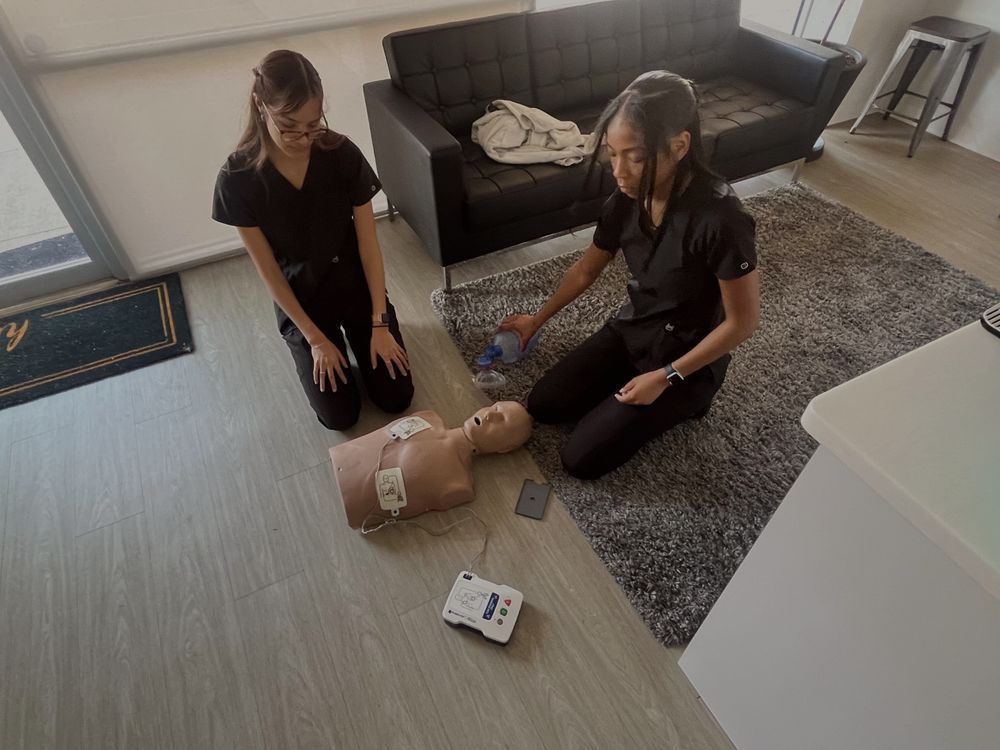
- Hands-on clinical practice — phlebotomy, vitals, injections, EKGs, sterilization
- Real equipment, real feedback — supervised by experienced instructors
- Scheduled at key intervals throughout the 16 weeks
CCMA certification included
- Exam prep is woven throughout the entire curriculum
- The NHA exam fee is included in your $2,990 tuition
- You graduate ready to sit for the Certified Clinical Medical Assistant exam
What you’ll learn
Clinical skills:
- Vital signs — blood pressure, heart rate, temperature, O2 saturation
- Phlebotomy — venipuncture, specimen handling, tube order, safety protocols
- Injections — intramuscular, subcutaneous, intradermal technique
- EKG/ECG — lead placement, 12-lead procedures
- Infection control — sterilization, PPE, OSHA compliance
- Assisting during patient exams and procedures
Administrative skills:
- Patient scheduling and check-in
- Electronic health records (EHR) navigation
- Insurance verification and billing basics
- HIPAA compliance
- Professional patient communication
The cost: $2,990, graduate debt-free
Pulse’s tuition covers everything — materials, lab access, and your CCMA exam fee. Weekly payment plans are available so you can train without taking on loans. By design, students graduate debt-free.
Who Pulse is built for
- Career changers — no prior healthcare experience required
- Working adults — the online-first format works around your schedule
- Parents and caregivers — no full-time classroom commitment
- Budget-conscious students — $2,990 total, no hidden fees, no debt
Start your healthcare career
Ready to start a healthcare career without the debt? Here’s your next step.
- Explore the program: Program details
- Review tuition and payment plans: Tuition
- Talk to our team: Contact
- Apply today: How to apply
You're only a few months from the medical assistant career you deserve.