Online Medical Assistant Programs: How to Train From Home and Still Get Hired

The appeal of online medical assistant programs is obvious: train from home, work around your schedule, and enter healthcare without sitting in a classroom five days a week. But the reality of medical assisting is that it’s a hands-on clinical job. You draw blood. You give injections. You run EKGs. You take vitals on real patients who are nervous, in pain, or in a hurry. No amount of video lectures can teach your hands how to do those things.
That’s the fundamental tension with fully online programs — and it’s why the best online medical assistant programs aren’t fully online at all. They’re hybrid: online for the knowledge, in-person for the skills.
What Online Medical Assistant Programs Can — and Can’t — Teach You
What works well online
- Medical terminology and anatomy/physiology
- Healthcare law, ethics, and HIPAA compliance
- Insurance verification and billing concepts
- EHR documentation principles and workflows
- Pharmacology fundamentals
- Professional communication strategies
- CCMA exam content review
What requires hands-on practice
- Phlebotomy — you need to feel the resistance of a vein, manage the angle of the needle, and handle a patient who’s about to pass out
- Injections — intramuscular, subcutaneous, and intradermal technique each require different angles, depths, and muscle memory
- EKG lead placement — positioning electrodes correctly on a real person’s body
- Vital signs — auscultating blood pressure, palpating a pulse, using a pulse oximeter
- Sterile technique — gloving, gowning, instrument handling, and operatory disinfection
- Patient interaction — managing anxious patients, taking accurate histories, communicating clearly under pressure
Any program that claims to teach these skills through video alone is leaving a critical gap in your training.
How Pulse Medical Assistant School Combines Both
Pulse’s 16-week program is designed around a hybrid model that delivers online flexibility without sacrificing clinical competency:
Online sessions (the majority of your week)
- Live, instructor-led classes — not pre-recorded videos you watch alone
- Real-time interaction with instructors and classmates
- Weekly assignments, reading, and practice activities
- CCMA exam content integrated throughout every module
- Flexible scheduling built for working adults and parents
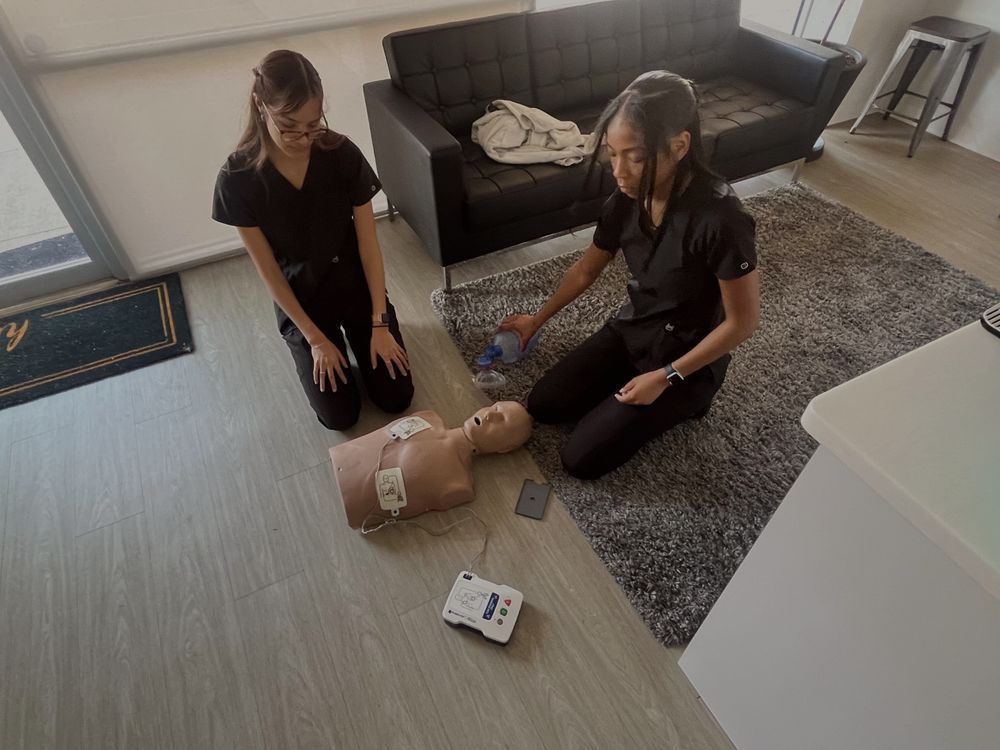
In-person clinical labs (4 intensive sessions)
- Hands-on practice with phlebotomy, injections, EKGs, vitals, and sterilization
- Real medical equipment, real clinical scenarios, real instructor feedback
- Spread across the 16-week program so skills build progressively
- Where the online knowledge becomes physical competence
Externship
- Supervised clinical experience in a real medical office
- Apply every skill you’ve learned with actual patients
- Build professional connections that lead to job offers
This structure means you’re not choosing between convenience and quality. You get both.
How to Evaluate Online Medical Assistant Programs
Not all programs are built the same. Before enrolling, ask these questions:
1. Does it include in-person clinical training?
If the answer is no, think carefully about whether you’ll be competitive against candidates who trained hands-on. Employers notice the difference.
2. What certification does it prepare you for?
Look for programs that prepare you for the CCMA (Certified Clinical Medical Assistant) credential from the National Healthcareer Association. It’s the most widely recognized certification and the one most employers prefer.
3. Is it instructor-led or self-paced?
Self-paced programs offer maximum flexibility but minimal accountability. Live, instructor-led sessions keep you engaged, allow real-time questions, and create a cohort experience that self-study can’t replicate.
4. Is an externship included?
An externship in a real medical office is where training becomes experience. Programs without externships leave you without the supervised patient care that employers value most.
5. What does it cost — and is student debt involved?
Pulse’s tuition is $2,990 with weekly payment plans. No student loans. You graduate debt-free and keep your full paycheck from day one.
The Job Market for Medical Assistants
The Bureau of Labor Statistics projects 14% growth in medical assistant employment through 2032 — nearly triple the average for all occupations. The median salary is approximately $42,000 per year, with certified medical assistants and those in specialty practices earning more.
This demand is driven by expanding outpatient care, an aging population, and healthcare systems relying on medical assistants to maximize provider productivity.
Who Online Medical Assistant Programs Work For
- Working adults who can’t attend weekday classes
- Parents and caregivers who need schedule flexibility
- Career changers entering healthcare for the first time
- People in areas without a local in-person program nearby
- Self-motivated learners who thrive with structured online coursework
Ready to Start?
- See the full program: Program details
- Review tuition and payment plans: Tuition
- Talk to our team: Contact
- Apply: How to apply
You're only a few months from the medical assistant career you deserve.